
Ever feel like your to-do list is a full-on tavern brawl, with tasks swinging from the rafters and exploding like cheap fireworks on Canada Day? Urgent crap flying everywhere while the important stuff gets buried under a pile of empty tankards?
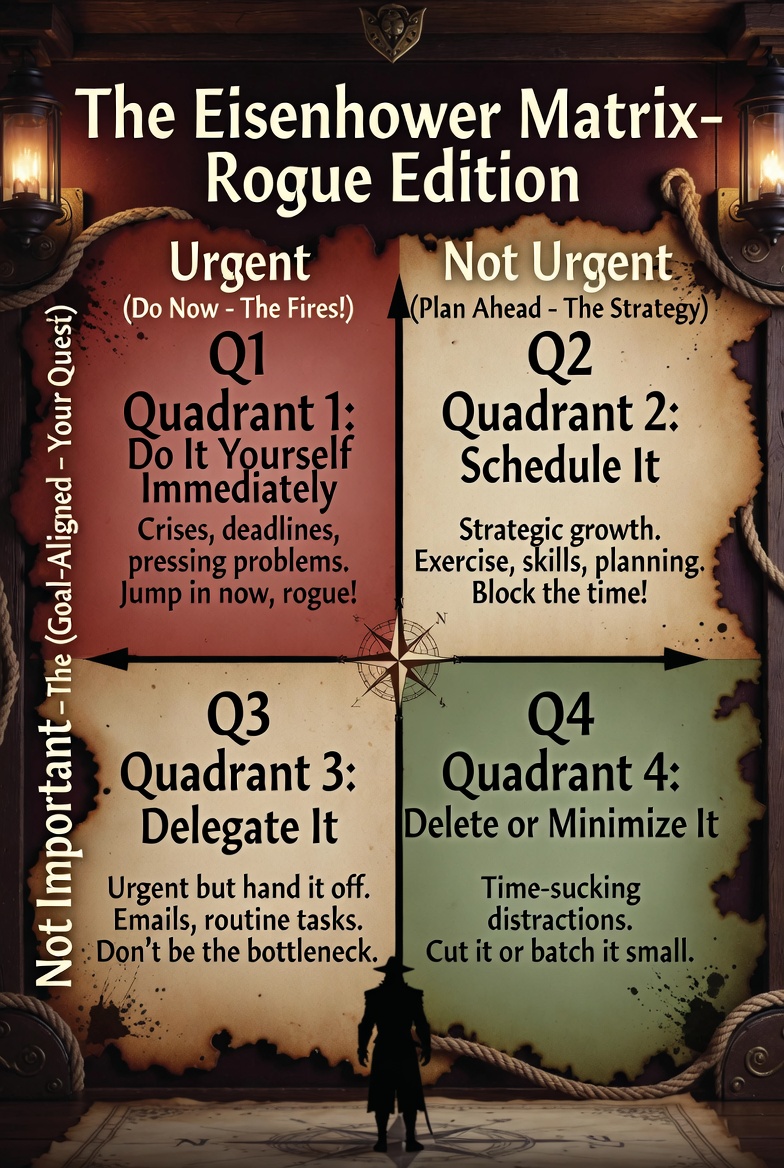 Well, hold on tight, fellow rogues – enter the Eisenhower Matrix. This no-BS tool for cutting through the madness is named after Dwight D. Eisenhower, that battle-hardened 34th U.S. President and five-star general who knew a thing or two about leading charges and getting shit done. He famously quipped, “What is important is seldom urgent, and what is urgent is seldom important.” The man lived by ruthless prioritization, and this simple 2×2 grid distills his hard-won wisdom into pure rogue gold.
It’s your decision-making weapon that sorts tasks by urgency (does it need to happen right now or the whole place burns down?) and importance (does it actually move you toward your big goals, your oasis adventures, your real life?).
The real magic? It forces you to face what’s truly worth your sweat and blood, slicing through the endless emails, pinging notifications, and those “quick” distractions that eat your whole afternoon. No more running around like a headless chicken firefighting every shiny object – you focus on what really counts and build something solid.
How the Matrix Works
Picture a square split into four quadrants, like a strategic map for your daily battlefield. One axis: Urgency – high or low. Other axis: Importance – high or low. Drop your tasks in there and suddenly everything gets crystal clear, like finding the right trail marker on a foggy hike.
Here’s the breakdown in table form, rogue-style, for easy scanning:
| Urgent (Do Now – The Fires!) | Not Urgent (Plan Ahead – The Strategy) | |
|---|---|---|
| Important (Goal-Aligned – Your Quest) | Quadrant 1: Do It Yourself Immediately Crises, looming deadlines, pressing problems that bite you in the ass if ignored. Examples: Fixing a server crash on your WordPress site, prepping for a client demo, or handling a family emergency. Action: Jump on it now, rogue. Your energy saves the day and keeps bigger disasters at bay. | Quadrant 2: Schedule It The strategic stuff that builds your future and keeps you ahead of the game. Examples: Exercise, skill-building (like mastering a new tool or perfecting that sourdough starter), or planning your next project, hike, or roadmap. Action: Block time in your calendar like it’s non-negotiable. This is the proactive sweet spot – Eisenhower’s real secret to staying on top. Ignore it and you’ll drown in Quadrant 1 chaos later. |
| Not Important (Low Impact – The Distractions) | Quadrant 3: Delegate It Things that scream for attention but someone else (or automation) can handle just fine. Examples: Non-critical emails, routine admin, or basic team check-ins. Action: Hand it off to a VA, colleague, or set up a system. Stop being the bottleneck in your own operation. | Quadrant 4: Delete or Minimize It Pure time-sucking distractions. Examples: Endless social scrolling, low-value meetings, or binge-watching “just one more episode.” Action: Cut it out or batch it small (like 15-minute doom-scroll windows). This quadrant is a thief in the night – reclaim your time and your life by showing it the door. |
Why It Rocks (And How to Actually Use It, Rogue-Style)
This isn’t fluffy theory, folks – it’s battle-tested in the trenches. Productivity experts like David Allen and Stephen Covey popularized it, and studies show it can boost your output by 20-30% just by killing decision fatigue. Eisenhower used it to juggle D-Day-level stuff while running a whole country. If it worked for him, it’ll work for keeping your WordPress sites humming, your garden growing, your recipes legendary, and your rogue adventures on track.
Rogue’s Quick Start Battle Plan:
- Brain Dump: Grab a pen, your notes app, or whatever – spill out 10-20 tasks rattling around in your head. No filtering, just get ‘em out.
- Plot ‘Em: Ask for each one: “Urgent? Important to my goals and values?” Be brutally honest – this is about owning your decisions, whether that’s family time, building the business, or hitting the trails.
- Act: Spend most of your prime time in Quadrant 2 – prevention beats cure every damn time. Review the matrix weekly to stay sharp.
- Tools to Hack It: Use Todoist, Notion, a simple paper grid, or whatever works for you. Color-code it – red for those Q1 fires, green for Q2 growth adventures.
Pro Tip: Start small, my friend. Next time your phone dings with another “urgent” ping, pause and quadrant it. Q3? Delegate or automate. Q4? Mute the bastard. You’ll feel the shift – like trading a rusty old truck for a well-tuned rig ready for any backroad.
In a world yelling for your attention from every direction, the Eisenhower Matrix lets you whisper back: I decide what matters. You’re the captain of this ship, Rogue.
What’s one task you’re going to quadrant and conquer today? Drop it in the comments or shoot me a message – let’s keep that rogue spirit strong at the Oasis.
Some History on The Eisenhower Matrix
The Roots: Not Actually Invented by Eisenhower as a Fancy Grid
Dwight D. Eisenhower — five-star general, Supreme Commander of Allied Forces in Europe during WWII, and the 34th President of the United States — never drew up a cute 2×2 table and called it “the Eisenhower Matrix.” He was too busy planning D-Day, running NATO, and steering a nation to sit around making pretty charts.
What he did have was a hard-earned philosophy about priorities that came from a lifetime of high-stakes decisions. The famous line most people slap on the matrix is:
“What is important is seldom urgent, and what is urgent is seldom important.”
Eisenhower didn’t even claim that as his own original quote. In a 1954 speech at Northwestern University (to the Second Assembly of the World Council of Churches), he told the audience he was quoting an unnamed “former college president” who said something very close:
“I have two kinds of problems, the urgent and the important. The urgent are not important, and the important are never urgent.”
That distinction — separating the screaming fires from the deep, meaningful work — was the real seed. Eisenhower lived it. As a general and president, he juggled life-or-death crises while trying to keep focus on long-term strategy. He knew that if you let the “urgent” stuff run your day, the truly important things (building alliances, planning for peace, investing in the future) would get starved.
How the Matrix Was Born
The actual visual 2×2 grid — the one we now call the Eisenhower Matrix or Urgent-Important Matrix — came later. It was popularized (and visually formalized) by Stephen R. Covey in his blockbuster book The 7 Habits of Highly Effective People (1989). Covey turned Eisenhower’s wisdom into a practical tool: a simple square divided into four quadrants based on urgency vs. importance.
Covey didn’t invent the idea either — he gave full credit to Eisenhower’s philosophy and built the framework around it as part of Habit 3: “Put First Things First.” That’s why the tool carries Eisenhower’s name even though he never drew the box himself.
David Allen (of Getting Things Done fame) and other productivity thinkers also helped spread variations, but Covey’s version is the one that stuck and got the “Eisenhower” label.
Why It Feels So “Eisenhower”
The man was a master of ruthless prioritization under pressure. He had to decide what deserved his personal attention versus what could be delegated to generals, staff, or systems. The core insight he lived by — and that the matrix captures — is this:
- Urgent tasks demand your immediate attention (they scream, they have deadlines, they create consequences if ignored).
- Important tasks move your long-term goals, values, and legacy forward (they’re often quieter and easier to postpone).
Most people confuse the two and spend their lives in reactive mode, putting out fires while their big dreams gather dust.
Eisenhower’s approach helped him lead one of the largest military operations in history and serve as president without completely burning out. That’s rogue-level time management.
Bottom Line, Rogue Style
The Eisenhower Matrix isn’t some modern productivity gimmick dreamed up in a Silicon Valley office. It grew out of real battlefield and Oval Office wisdom — distilled from a leader who knew the difference between what was on fire today and what would actually matter ten years from now.
It’s a reminder that in the great tavern brawl of life, you don’t have to swing at every tankard thrown your way. You get to choose where you put your blade.
So next time your to-do list feels like a chaotic raid, pull out the matrix and ask the old general’s question: Is this urgent… or is it important?
That’s the rogue way to cut through the noise and actually build something that lasts.
What part of the origins surprises you most, or want me to dig deeper on?